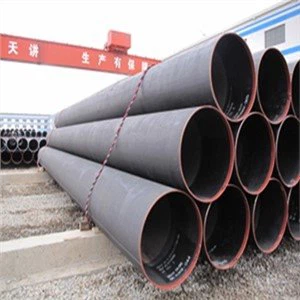
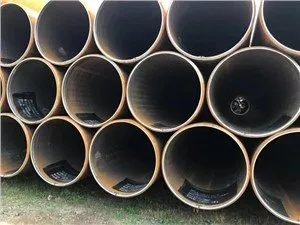
FBE anti-corrosion steel pipes are corrosion-resistant pipelines that use the fusion-bonded epoxy powder (Fusion Bonded Epoxy, abbreviated as FBE) coating technology. They are widely applied in anti-corrosion projects in fields such as oil, natural gas, municipal water supply, and chemical industries. By applying epoxy powder at high temperatures to the surface of the steel pipe, a dense, continuous, and highly adhesive anti-corrosion layer is formed, effectively isolating corrosive media and providing long-term protection.
The main features of FBE anti-corrosion steel pipe include:
Excellent adhesion: FBE coating is firmly combined with steel pipe substrate, not easy to peel, ensuring long-term anti-corrosion effect.
Strong resistance to chemical corrosion: can resist the erosion of acid, alkali, salt and other chemical media, suitable for complex environment.
Good high temperature resistance: the working temperature range is usually-30℃ ~ 100℃, which meets most industrial requirements.
Environmentally friendly and non-toxic: FBE materials meet food grade standards and can be used in drinking water delivery pipes.
In the fields of oil and gas gathering pipelines, urban networks, and chemical pipelines, FBE anti-corrosion steel pipes have become the preferred choice for basic corrosion protection due to their reliable anti-corrosion performance and high cost-effectiveness. At the same time, FBE anti-corrosion steel pipes are often used as the base coating for 3PE and 3PP anti-corrosion steel pipes, further enhancing the overall performance of the composite corrosion protection system.
The performance of FBE anti-corrosion steel pipe is closely related to the type of coating. Based on impact resistance and high-temperature resistance, it is divided into different types:
Standard fusion-bonded epoxy powder: 100-150μm thickness, adhesion ≥7MPa, impact resistance ≥3J, suitable for low-stress buried pipelines;
Thick-film fusion-bonded epoxy: 200-400μm thickness, adhesion ≥6MPa, impact resistance ≥5J, suitable for high-stress pipeline systems;
High-temperature fusion-bonded ethylene oxide: resistant to temperatures of 150-180°C, heat aging resistance at 180°C for 168 hours without cracking, suitable for high-temperature pipeline systems.
Choosing the FBE anti-corrosion steel pipe coating type based on the application scenario not only achieves the desired effect but also reduces costs.
Quality is fundamental to the longevity of a product. During the production process, we must ensure critical control points for FBE anti-corrosion steel pipes, particularly those that determine coating quality and require comprehensive process control.
Preheating temperature: This temperature must be adjusted based on the powder gelation time. If the gelation time is short, the temperature should be lower, typically 180-220°C. If the gelation time is long, the temperature should be higher, typically 200-220°C. Insufficient powder melting will result in a dull coating and wrinkling. Excessive temperature, exceeding 220°C, can lead to carbonization of the powder, resulting in yellowing and brittleness.
Temperature uniformity: The temperature difference between the circumferential and axial directions of the steel pipe must be ≤±10°C. This is achieved through multi-zone temperature control in a medium-frequency induction heating furnace. Excessive temperature differences can lead to uncured coating in low-temperature areas and carbonization in high-temperature areas, resulting in a "yin-yang" ("yin-yang") defect.
Temperature control is crucial during the production of FBE anti-corrosion steel pipes. Temperatures can be tested periodically and adjusted promptly if any discrepancies are detected.
Hot Tags: fbe anti-corrosion steel pipe, China, suppliers, manufacturers, factory, wholesale, cheap, discount, coating corrosion resistance testing, transfer coating, coating thickness measurement, coating chemical resistance testing, textured coating, coating surface energy measurement