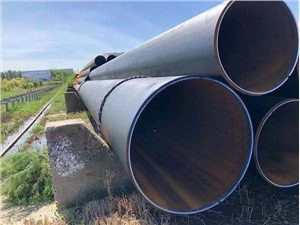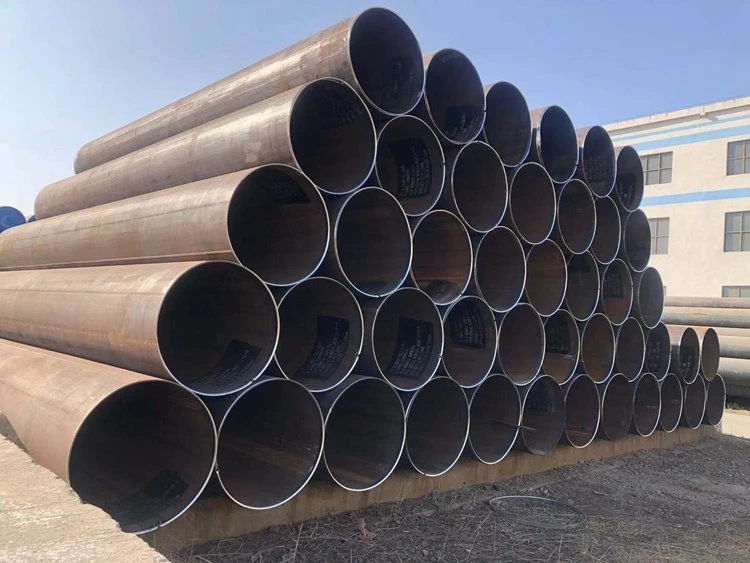
EFW stands for electric arc welding process, which differs from ERW and HFW resistance welded pipes without filler wire. During the entire production process, alloy welding wire matching the base material is added for multi-layer filler welding. The mainstream method adopts JCOE plate forming + internal and external double-sided submerged arc welding process, resulting in fully fused welds with a dense internal structure free of slag inclusions. The base material is ASTM A387 series chromium-molybdenum alloy container steel plate, covering carbon-molybdenum and chromium-molybdenum alloy steels such as 1Cr, 1.25Cr, 2.25Cr, and 9Cr. The alloying elements significantly improve the pipe's high-temperature creep resistance, making it suitable for continuous operation in environments with pressures of 10–35 MPa and temperatures of 400–600℃. After forming and welding, a standardized post-weld heat treatment process is applied, using normalizing and tempering to eliminate residual welding stress. Finished products undergo 100% non-destructive testing using radiographic testing (RT) and ultrasonic testing (UT), and each piece undergoes a hydrostatic test to rigorously ensure pressure resistance and meet the acceptance requirements of pressure vessel and pressure pipeline standards.
Flexible customization is available; large diameters and thick walls can be produced. Small-batch sample production is supported, and large-scale batch orders for large projects are also accepted.
Our own production line boasts high production efficiency, reducing delivery time for the same specifications by 15–20 days compared to the industry average, ensuring uninterrupted project construction schedules.
We maintain a regular inventory of standard sizes for fast delivery of urgent orders; we support partial delivery as needed, suitable for phased construction projects.
We offer one-stop supply of matching flanges, elbows, tees, and other pipe fittings, eliminating the need for customers to compare prices from multiple suppliers and reducing communication costs.
Applications include: Thermal power generation: main steam pipelines for supercritical units, high-temperature conveying pipelines for boiler headers; Oil refining and petrochemical industry: high-temperature and high-pressure process pipelines for hydrogenation units, heating furnaces, and reforming units; Coal chemical and synthetic ammonia industry: straight pipes for high-pressure reaction media transportation, reactor supporting pipelines; Large pressure vessel support: large-diameter, thick-walled connecting pipes for equipment inlets and outlets.
High-voltage electrofusion welded carbon alloy steel pipes combine large-diameter customization capabilities, thick-walled pressure-bearing performance, and high-temperature stability. Relying on the mature submerged arc welding process, they achieve stable mass production and have a significant cost advantage compared to seamless alloy pipes. With complete heat treatment and full-process non-destructive testing, the mechanical properties of the weld are highly matched with the base material. They are the preferred solution for large-diameter applications in high-temperature and high-pressure industrial pipelines and are also the mainstream pressure-bearing welded pipe category for export procurement in global energy infrastructure projects.
Hot Tags: high-voltage electrofusion welded carbon alloy steel pipe, China, suppliers, manufacturers, factory, wholesale, cheap, discount, alloy steel pipe, steel pipe for chemical industry, steel pipe for distribution centers, steel pipe for irrigation, steel pipe for manufacturing equipment, steel pipe for saunas