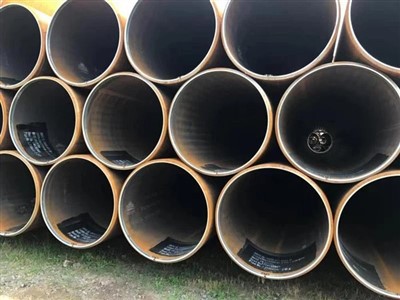
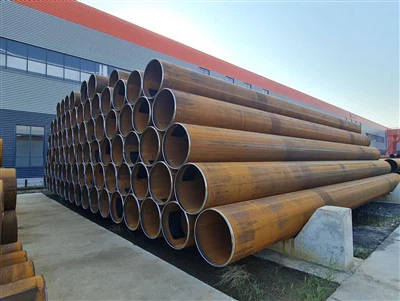
Its production process isn't overly complicated, but each step determines its service life. The original manufacturer first performs shot blasting to achieve Sa2.5 grade rust removal, thoroughly cleaning the pipe wall of oxide scale and impurities. Then, the pipe is heated at a constant temperature using medium frequency, simultaneously coating it with double-layer anti-corrosion material. After water cooling and shaping, bare weld joints are left. Finally, each pipe undergoes spark leak testing. With no unnecessary processes and a one-piece coating, it's less prone to peeling or flaking during construction and handling, and can easily withstand impacts during on-site hoisting and landfilling.
Objectively speaking, it's not an all-around anti-corrosion pipe material; its advantages and disadvantages are quite distinct, and there's no need to blindly exaggerate its performance when purchasing. Its advantages are readily apparent. First, its cost-effectiveness is outstanding. For the same specifications, it costs about 20% less than conventional 3PE anti-corrosion steel pipes. For small to medium-sized projects, bulk purchasing can save a considerable amount of budget. Polyethylene material has extremely low water absorption, stable water and oxygen barrier properties, and is resistant to daily weak acid and alkali corrosion. In neutral soil environments, it can be used stably for approximately thirty years without problems. Moreover, the pipe material has good toughness and is not prone to brittleness in low-temperature environments, making it suitable for outdoor buried construction in northern regions.
In terms of application scenarios, due to its excellent comprehensive performance and economy, 2PE anti-corrosion steel pipes are mainly suitable for buried pipeline projects in ordinary soil environments. Specific applications include general buried water supply and drainage systems, agricultural irrigation and drainage systems, onshore oil and gas transmission and urban heating networks, as well as infrastructure construction such as water and gas pipelines in ordinary soil environments.
The production process involves first subjecting the base pipe (seamless, straight seam, or spiral welded pipe) to medium-frequency heating and sandblasting for rust removal. Then, a hot-melt adhesive is applied, followed immediately by extrusion or side-winding of high-density polyethylene, fusing the two layers together in a molten state to adhere tightly to the pipe wall. There are two main processing methods: spiral winding and circular mold coating. The preheating temperature of the steel pipe is typically controlled between 200 and 240℃.
The market offers a wide variety of anti-corrosion pipe materials, leading many projects to fall into the misconception that "the more expensive, the better." However, for ordinary residential pipelines, it's unnecessary to insist on top-of-the-line anti-corrosion technology. Two-layer polyethylene anti-corrosion steel pipe strikes the perfect balance for essential projects: sufficient anti-corrosion, wear resistance, easy construction, and affordable cost. Regardless of whether seamless, straight seam, or spiral base materials are chosen, double-layer anti-corrosion can be customized. Pipe diameters are compatible with mainstream specifications from DN200 to DN500, with fast delivery and simple pipe end repair processes, reducing on-site construction difficulty.
When selecting materials for a project, suitability always outweighs high-end options. Without seeking redundant performance, but only aiming to adapt to working conditions, reduce later repairs, and strictly control project costs, this mature and stable two-layer polyethylene anti-corrosion steel pipe is a reliable and dependable choice for engineering materials.
Hot Tags: two-layer polyethylene anti-corrosion steel pipe, China, suppliers, manufacturers, factory, wholesale, cheap, discount