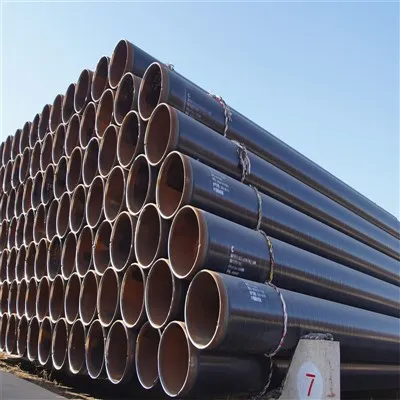
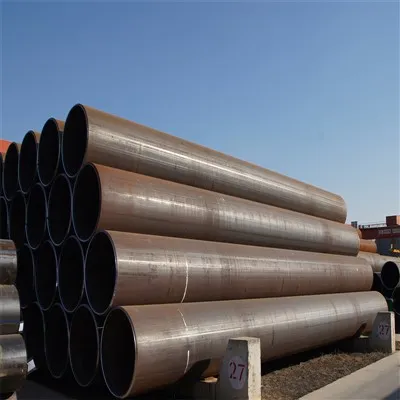
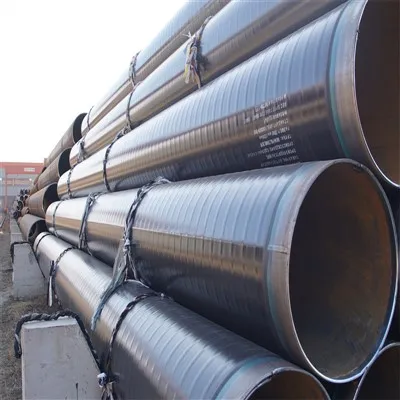
Anti-corrosion LSAW pipe (anti-corrosion straight seam submerged arc welded pipe) is a high-end pipe material that significantly improves the corrosion resistance of ordinary LSAW pipe through professional anti-corrosion treatment. It is widely used in highly corrosive environments such as oil and gas transportation, marine engineering, chemical pipelines, and municipal water supply and drainage. Its core value lies in its precise adaptation to complex corrosive environments. Through a scientific and reasonable anti-corrosion process, it blocks corrosive media from eroding the pipe substrate, extending service life and reducing operation and maintenance costs.
The core anti-corrosion process of LSAW pipe is not a single process, but a combined system of "substrate pretreatment + core anti-corrosion coating + auxiliary protection". Substrate pretreatment is the foundation, the core anti-corrosion coating is the key, and auxiliary protection is the guarantee. The three work together to achieve long-term anti-corrosion. First is the substrate pretreatment process, which is the prerequisite for ensuring the adhesion of the anti-corrosion coating and improving the anti-corrosion effect. It is also a key link that is easily overlooked.
The core of substrate pretreatment is to remove impurities from the surface of the LSAW pipe, creating a clean and rough surface for subsequent coating application. The specific process consists of three steps: The first step is rust removal, using shot blasting. A high-speed rotating shot blasting machine sprays steel shot onto the LSAW pipe surface to thoroughly remove rust, scale, welding slag, and other impurities. This also creates a uniformly rough surface, enhancing the adhesion between the coating and the substrate and preventing coating peeling. The second step is degreasing, using a professional degreasing agent to clean oil and dust from the pipe surface, preventing oil from affecting coating adhesion and ensuring uniform coating coverage. The third step is drying, drying the degreased and rust-removed pipe to remove residual moisture, preventing blistering and peeling of the coating, and ensuring the pretreated pipe surface meets anti-corrosion construction standards.
The core anti-corrosion coating process is the essence of LSAW anti-corrosion pipes. Currently, the mainstream processes are divided into two main categories: hot-dip galvanizing and anti-corrosion coating, which can be flexibly selected according to the corrosion intensity of the application scenario. Hot-dip galvanizing is suitable for outdoor, humid, and other moderately corrosive environments. Its process is similar to that of ordinary galvanized pipes, where the pre-treated LSAW pipe is immersed in molten zinc, forming a dense zinc layer on the pipe surface. Through the dual action of "physical isolation + electrochemical protection," corrosion protection is achieved. The zinc layer has uniform thickness and strong adhesion, effectively resisting the erosion of rainwater and moisture, and its service life can reach 15-20 years.
Anti-corrosion coating processes are suitable for highly corrosive environments such as chemical and marine industries. Two commonly used coatings are 3PE anti-corrosion coatings and epoxy coal tar coatings. 3PE anti-corrosion coatings employ a three-layer structure: epoxy powder, adhesive, and polyethylene. The epoxy powder layer adheres to the substrate, serving as a priming layer for corrosion protection; the adhesive layer connects the epoxy powder and polyethylene layer, enhancing adhesion; and the polyethylene layer acts as an outer layer, providing physical isolation. This synergistic effect of the three layers results in excellent anti-corrosion performance, resisting strong corrosive media such as acids, alkalis, and salt spray, making it suitable for high-pressure and highly corrosive environments. Epoxy coal tar coatings, on the other hand, offer advantages such as moderate cost and convenient application. They form a dense anti-corrosion layer through brushing, making them suitable for underground pipelines, chemical equipment, and other similar applications.
Auxiliary protection processes supplement the service life of LSAW pipes, mainly including joint corrosion protection treatment and anti-corrosion layer inspection. Joint corrosion protection is the key point, as weak points in corrosion protection are prone to occur at the splicing joints of LSAW pipes. These joints must be treated using methods that match the main corrosion protection process. For example, hot-dip galvanized pipe joints are treated with thermal spray zinc, and 3PE coated pipe joints are treated with a repair coating to ensure that the joint corrosion protection is consistent with the main body. Anti-corrosion layer inspection uses non-destructive testing technology to check for problems such as damage, missed coating, and bubbles in the coating, and repairs are made in a timely manner to ensure the integrity of the anti-corrosion system.