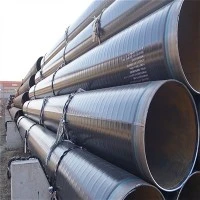
Thick-walled LSAW pipe, also known as thick-walled straight-seam submerged arc welded pipe, is widely used in high-end fields such as oil and gas transportation, high-pressure pipeline engineering, marine engineering, and industrial equipment manufacturing due to its advantages such as uniform wall thickness, high weld quality, and high compressive strength. Its production process is complex and rigorous, with each step directly affecting the quality and performance of the pipe. The production process consists of five major stages: raw material pretreatment, forming, welding, inspection, and finished product processing.
The first step is raw material pretreatment, which is the foundation of production. The raw material for thick-walled LSAW pipes is thick-walled steel plates, using high-strength low-carbon alloy steel or high-quality carbon steel. The steel plates undergo rigorous quality inspection to select qualified plates free of slag inclusions, cracks, and rust, ensuring uniform material quality and meeting performance standards. Next, surface treatment is performed through a series of processes such as shot blasting and pickling to remove rust, scale, and oil from the steel plate surface, preventing impurities from affecting welding quality and the pipe's corrosion resistance. Simultaneously, the steel plates are leveled to ensure flatness.
The forming process is the core of thick-walled LSAW pipe production, aiming to roll flat steel plates into square or round pipe blanks. Due to the thick walls, forming is more difficult than with ordinary thin-walled LSAW pipes, typically employing a three-step method: pre-bending, forming, and seam joining. First, the steel plate is pre-bent at both ends using a pre-bending machine, ensuring the edges conform to the curvature of the forming mold and preventing wrinkles or cracks on the edges of the formed pipe blank. Then, the pre-bent steel plate is fed into the forming machine, where it is gradually rolled into a round pipe blank conforming to specifications through rolling, mold positioning, and other methods, ensuring uniform outer diameter and wall thickness. Finally, seam joining is performed, adjusting the gap between the pipe blank joints to ensure alignment and flatness, preparing for welding.
The welding process is crucial to the quality of thick-walled LSAW pipes. It employs submerged arc welding (SAW) and consists of two steps: internal welding and external welding. SAW involves embedding the electric arc under a layer of flux, offering advantages such as good weld formation, high strength, and high welding efficiency, making it suitable for the welding requirements of thick-walled pipes. Internal welding is performed first, where the welding torch is inserted into the pipe blank to weld the inner side of the joint, ensuring a full, porosity-free, and slag-free weld. External welding is then performed, welding the outer side of the pipe blank joint to compensate for the shortcomings of the internal welding, forming a double weld. This enhances weld strength and prevents weld cracking during later use.
After welding, the thick-walled LSAW pipes undergo a comprehensive quality screening process during the inspection phase. Non-destructive testing techniques, including ultrasonic testing, radiographic testing, and magnetic particle testing, are employed. The focus is on inspecting the weld quality and pipe blank wall thickness, checking for defects such as cracks, porosity, and incomplete penetration in the welds. Simultaneously, the outer diameter and ovality of the pipe blank are measured to ensure compliance with design requirements. Substandard pipes must be repaired or scrapped to prevent inferior products from entering the market.
Finally, the finished product processing stage involves further processing of qualified thick-walled LSAW pipes. First, straightening is performed to adjust the straightness of the pipes and prevent bending or deformation. Then, depending on the application requirements, anti-corrosion treatments (such as hot-dip galvanizing or anti-corrosion coatings) are applied to improve the pipes' corrosion resistance and extend their service life. Finally, the pipes are cut, labeled, and packaged, with information such as specifications, material, and production batch number clearly marked for easy storage, transportation, and use.