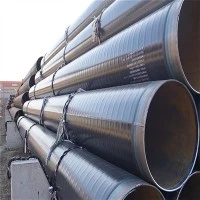
Oil and gas pipelines are characterized by high pressure, long distances, and complex operating conditions. Steel pipe selection directly determines safety, service life, and whole-lifecycle cost. Selection must be centered on operating conditions, systematically matching material, process, corrosion protection, and standards-rather than deciding solely based on price.
I. Define Operating Boundaries and Design Parameters
Selection locks in core parameters: pressure, medium, temperature, laying method, soil corrosion/geology-to prevent under- or over-design. Pressure → wall thickness/steel grade; sulfur/sand content → internal corrosion protection/wear resistance; soil resistivity/salinity → external corrosion protection. Special conditions: sour gas fields require HIC+SSC resistance (NACE MR0175); alpine regions require low-temperature impact toughness; deep-sea projects require external pressure/fatigue resistance and S-Lay/J-Lay requirements for ovality, straightness, and residual stress.
II. Match Pipe Material and Steel Grade
Mainstream standards: API Spec 5L (46th Ed.) and GB/T 9711-2017, divided into PSL1 and PSL2 levels. PSL2 has stricter requirements; preferred for trunk lines, high-pressure, and critical stations.
Common steel grades: X42~X80; X90~X100 are in trial sections:
• Low/medium-pressure branch lines/municipal networks: X42, X52
• Low/medium-pressure trunk lines: X60, X65
• Mainstream long-distance trunk lines: X60~X70
• High-pressure, large-volume trunk lines: X70~X80 (e.g., West-East Gas Pipeline, China-Russia Eastern Line)
Sour gas fields require special grades with HIC+SSC resistance; low-temperature regions require low-temp toughness grades (e.g., L450Q, L485Q).

III. Select Forming Process and Diameter Range
Each process has different applicable boundaries; weld joint coefficient must be noted: seamless 1.0, ERW ~0.85~0.95, LSAW/SSAW ~0.9~0.95.
• LSAW: Large-diameter thick-wall, above Φ406.4mm, stable weld, high pressure-bearing, mainstream for long-distance trunk lines.
• ERW: Small/medium-diameter low/medium-pressure, below Φ610mm, high efficiency, mostly for city branch lines/stations.
• Seamless: Small-diameter high-pressure, weld coefficient 1.0, used for station process pipes/fitting blanks/instrument pipes.
• SSAW: Low/medium-pressure large-diameter, low cost, mostly for municipal branch lines/low-pressure transmission.
Note: Hot-bent pipes must use a grade one level higher than the straight pipe, or same grade with higher toughness.
IV. Supporting Corrosion Protection System
Protection system: Coating + Cathodic protection.
• External corrosion protection: Buried pipes mainly use 3PE (FBE+adhesive+PE); thickened type for severe corrosion; overhead pipes should not use pure FBE, use weather-resistant systems (polyurethane/acrylic polyurethane); high temperature (>110°C) uses phenolic epoxy or modified coatings.
• Internal corrosion protection: Gas trunk lines use drag-reducing coatings; corrosive/sandy media use corrosion-resistant linings or wear-resistant coatings.
• Cathodic protection: Standard for buried long-distance lines, sacrificial anodes (Mg/Zn) or impressed current, compensating for coating defects.
V. Standard Compliance and Quality Inspection
Clarify standards and inspection to control quality at the source.
• Product standards: Domestic GB/T 9711-2017, international/export API Spec 5L, subsea supplemented by DNV-ST-F101, ISO 3183.
• NDT: Full coverage of welds by AUT or RT; surface/near-surface by MT or PT. High-grade thick-wall pipes may use NDT combination to replace hydrostatic test (specified in design documents).
• Incoming re-inspection: Dimensions, bevel quality, markings, batch traceability; non-conforming items returned/downgraded/concession accepted, with pre-defined authority.
• Resident inspection: Third-party recommended for critical pipelines, reviewing WPS/PQR, initial inspection, and key control points.
VI. Core Selection Principles
• Appropriate safety margin: Steel grade and wall thickness match design pressure; blind upgrades increase cost and welding difficulty.
• Whole-lifecycle cost: Balance purchase price, construction efficiency, and service life; prefer solutions with lower long-term O&M costs.
• Construction adaptability: Prioritize 12m fixed-length pipes to reduce welds; consider transport limits.
• Traceability: Provide complete material certificates (MTC), inspection reports, and production records.
Steel pipe selection for oil and gas pipelines is a systematic task that must integrate operating conditions, standards, and costs. Layer-by-layer matching from material grade and forming process to corrosion protection system, while considering details like weld coefficient, hot-bent pipes, and laying methods, ensures long-term safe and stable operation and optimal comprehensive benefits.