


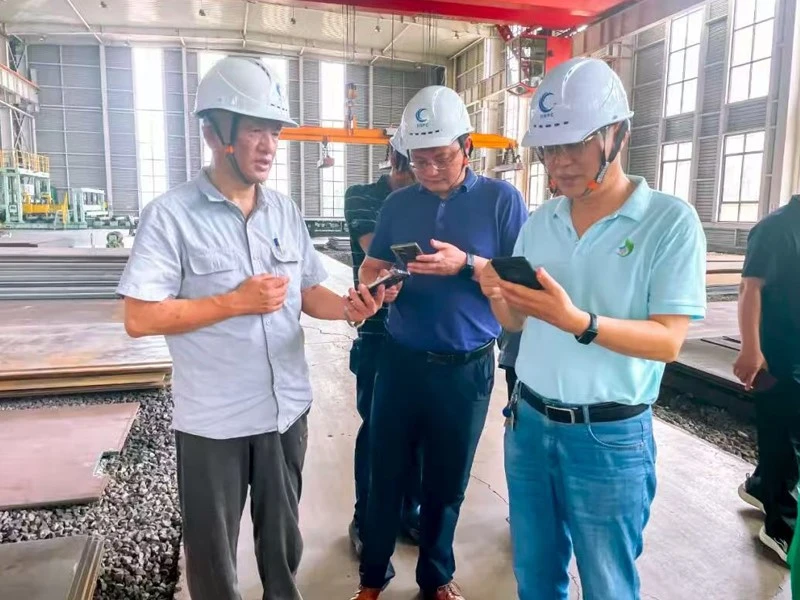
Professors Cui Haiting and Zhong Weizhang of Hebei University of Science and Technology visited Hebei Haiqianwei Steel Pipe Co., Ltd. to discuss green factory construction and the application of new energy technologies. Shang Caizhong, the company's chief engineer, accompanied them throughout the visit and focused on introducing the JCOE new energy pipeline production line and its green manufacturing achievements. The two sides discussed in depth topics such as hydrogen pipeline technology and carbon accounting system optimization. Shang Caizhong stated, "Haiqianwei has consistently implemented the 'green factory' concept, promoting technological innovation through industry-university-research collaboration and supporting the implementation of the 'dual carbon' strategy." Haiqianwei will continue to empower green transformation through technological innovation and collaborate with universities and research institutions to build a new low-carbon development ecosystem.
The green factory upgrades materials when producing European piling pipes. The use of low-carbon, environmentally friendly materials achieves a recyclability rate of ≥90%, while reducing CO₂ emissions during production by over 30% compared to traditional steel. The "inner layer of corrosion-resistant alloy + outer layer of low-carbon steel" structure increases material utilization by 40% and extends service life to 15-20 years.
The production of European piling pipes can significantly reduce energy consumption and emissions per unit product through a combination of "energy-saving equipment + process optimization + digital energy efficiency management." Lowering production costs means lowering procurement costs, all with the customer's best interests in mind.
In 2025, demand for single piles in the European offshore wind foundation market is expected to reach 290,000-440,000 tons, a year-on-year growth rate exceeding 100%. Demand in the UK, Germany, and the Netherlands accounts for 65% of the total. Single pile diameters are increasing from 6 meters to 8 meters or more, and single pile weights are exceeding 2,000 tons. Ultra-high-strength concrete pipes offer a 50% improvement in crack resistance, making them suitable for deepwater projects.

European piling pipe, a key material in infrastructure construction, is primarily used in the following sectors:
Offshore wind power: Demand for single pile foundations in offshore wind power installations exceeds 80%, requiring piling pipe with a diameter of 6-8m and a weight of 2,000 tons;
Bridge engineering: Deepwater wharf construction requires large-diameter spiral-welded pipe piles up to 3,620mm, while cross-sea bridge foundations require Q345 high-strength steel piles;
High-rise buildings: High-rise buildings generally use C120 ultra-high-strength concrete pipe piles, which boast a compressive strength of 120 MPa;
Petrochemical: Corrosion resistance is crucial in the petrochemical industry, and piling pipe can improve crack resistance by 50%;
Environmental protection: Ecological restoration projects, such as the Amsterdam Wetland Project in the Netherlands, require bamboo-wrapped pipe piles, which have proven effective.
As a professional manufacturer of European piling pipe, we prioritize product quality during production to ensure every customer receives high-quality products.


