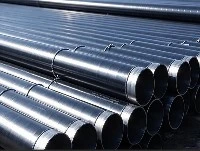
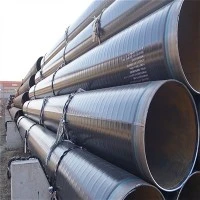
Straight seam welded steel pipe, also known in the industry as electric arc welded steel pipe or EFW steel pipe, is a high-quality welded pipe product widely used in industrial high-pressure, high-temperature, and low-temperature conditions. Unlike ordinary high-frequency resistance welded pipe, it is a straight seam pipe manufactured using an electric arc fusion welding process. The weld seam is straight along the longitudinal direction of the steel pipe, resulting in a regular overall structure and uniform stress distribution, making it a core material for large-diameter, thick-walled pipeline projects.
Many people easily confuse ordinary straight seam welded pipe with straight seam fusion welded steel pipe, but their production processes are fundamentally different. Ordinary straight seam resistance welded pipe relies on resistance heat extrusion bonding, without filler metal, resulting in limited weld toughness and pressure-bearing capacity. In contrast, straight seam fusion welded steel pipe uses medium-thick steel plates as raw materials. The steel plates are stamped and rolled into pipe blanks using specialized equipment, and then welded using electric arc welding processes such as double-sided submerged arc welding, along with welding wire and flux to fill the molten pool. This fusion welding method allows for a thorough metallurgical bond between the weld and the base material, resulting in a dense weld structure. It completely avoids problems such as incomplete welds, slag inclusions, and embrittlement that easily occur with extrusion welding, significantly improving the overall performance of the pipe.
In terms of production process, straight seam fusion welded steel pipes undergo rigorous processes and strict quality control. After forming, the pipes undergo precise diameter expansion and straightening to ensure that the roundness, wall thickness uniformity, and straightness meet standards. They then must pass 100% non-destructive testing, including ultrasonic and radiographic testing, and complete hydrostatic pressure testing. For some special pipes used in high-temperature and high-pressure applications, additional post-weld heat treatment is performed to eliminate welding stress, ensuring product stability and safety from a process perspective.
With its mature fusion welding technology, straight seam fusion welded steel pipes possess many outstanding advantages. Its specifications cover a wide range, enabling the production of large-diameter, thick-walled special pipes, perfectly suited for heavy-duty applications that conventional welded pipes cannot meet. It is also compatible with a variety of materials, including ordinary carbon steel, low-temperature carbon steel, heat-resistant alloys, stainless steel, and duplex steel, meeting diverse requirements for corrosion resistance, temperature resistance, and pressure resistance. Compared to seamless steel pipes, straight seam welded steel pipes offer higher cost-effectiveness, greater flexibility in specification customization, and overall performance comparable to seamless pipes, making them a viable alternative in most high-pressure industrial applications.
In the industry, this steel pipe has several common names. Besides the standard straight seam welded steel pipe and electric arc welded steel pipe, factories and engineering sites often refer to it as submerged arc welded straight seam steel pipe or double-sided submerged arc welded pipe. In the foreign trade sector, it is uniformly abbreviated as EFW steel pipe, which is also the general term for the mainstream LSAW straight seam submerged arc welded pipe. All these names refer to the same product manufactured using the same process.
Thanks to its stable and reliable performance, straight seam welded steel pipes have a wide range of applications. It is used as a core material in key industrial scenarios such as boiler steam pipelines and high-temperature heat pipe networks in power plants, high-pressure process pipelines and hydrogenation unit pipelines in petrochemical refineries, corrosion-resistant pipelines in offshore platforms and seawater desalination, as well as pipelines for coal chemical industry, large pressure vessels, and cryogenic liquid storage. It is an indispensable main material for pipelines in the heavy industry, energy, and chemical industries.